IT company · Software engineering
Rapaert
de Grass
We design and engineer custom software, web applications and cloud infrastructure — systems with clear structure, built to be understood, operated and changed for years.

02 — Introduction
Good software behaves like good architecture: its structure is visible, its load paths are deliberate, and it can be extended without being torn down.
Rapaert de Grass is an IT company focused on the engineering side of technology — planning, building and maintaining the software and infrastructure organisations rely on every day.
We work closely with the people who own and use each system, keep decisions documented, and favour approaches that remain maintainable long after the initial project is delivered.
03 — Core services
Six disciplines, one engineering standard.
- 01Custom softwarePurpose-built systems shaped around how your organisation actually works.
- 02Web applicationsBrowser-based products and internal tools engineered for clarity and longevity.
- 03Cloud & infrastructureEnvironments designed to be reproducible, observable and cost-aware.
- 04Integration & automationConnecting existing systems and removing repetitive manual work.
- 05Discovery & planningTechnical groundwork before commitments: scope, risks, architecture.
- 06MaintenanceOngoing care, upgrades and incremental improvement after launch.
04 — Custom software
Software shaped around your operations.
Off-the-shelf products suit common problems. When your processes, data or rules are specific, custom software lets the system follow the business rather than the other way round.
- Domain modelling that reflects real terminology and rules
- Modular architecture that separates concerns cleanly
- Data models designed for reporting and future change
- Documentation written alongside the code
05 — Web application engineering
Interfaces that stay fast, accessible and coherent.
Front end
Accessible, responsive interfaces with consistent design systems and careful attention to performance on real devices.
Back end
Well-defined APIs, authentication and authorisation, background processing and reliable data storage.
Delivery
Automated builds, tests and deployments so new versions can be released routinely and safely.

06 — Cloud & infrastructure
Infrastructure you can rebuild from a description.
We design cloud environments as code: versioned, reviewable and reproducible. Networking, access control, backups, monitoring and cost visibility are treated as first-class requirements, whether you are moving to the cloud, consolidating environments or tidying up what already exists.
07 — Systems integration & automation
Make your existing tools work as one.
Map
Identify where data originates, where it is copied and where it diverges.
Connect
Build integrations through APIs, events or scheduled synchronisation.
Automate
Replace repetitive manual steps with dependable, auditable workflows.
Monitor
Surface failures clearly, with retries and alerts instead of silent gaps.
08 — Product discovery & planning
Draw the plan before pouring the foundation.
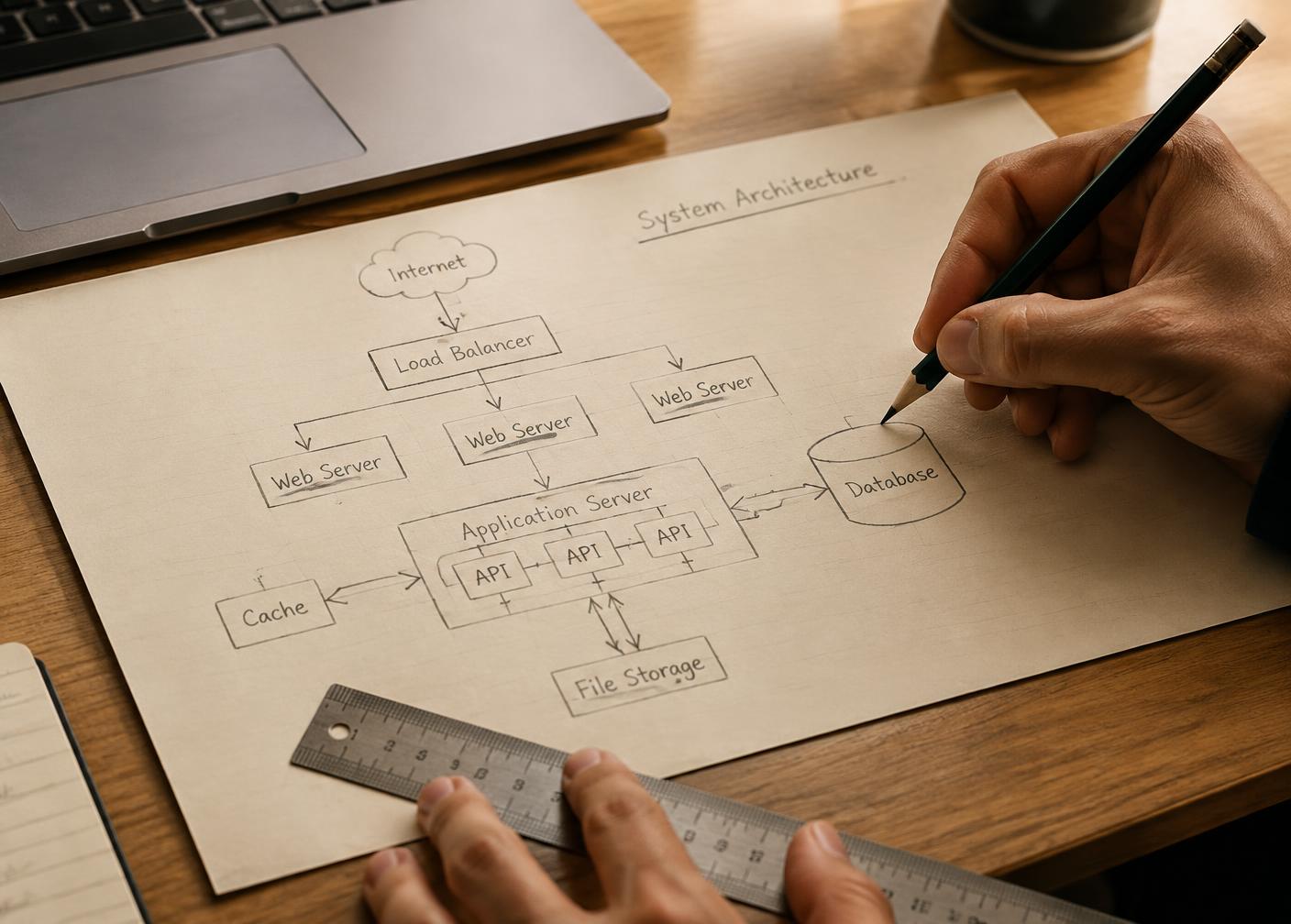
Discovery turns an idea or problem into something that can be estimated and built. We clarify goals, users, constraints and integrations, then outline an architecture and a phased delivery plan.
- Output
- Requirements summary
- Output
- Architecture outline
- Output
- Risk register
- Output
- Phased roadmap
09 — Delivery process
From first conversation to ongoing support.
- 01
Discover
Conversations with the people who will use and own the system. We map current workflows, constraints and what success should look like.
- 02
Define
A written scope, an architecture outline and an honest view of risks and open questions, agreed before larger work begins.
- 03
Build
Short iterations with working software reviewed regularly, so direction can be adjusted while change is still inexpensive.
- 04
Verify
Automated tests, code review and acceptance checks against the agreed scope, in an environment that mirrors production.
- 05
Release
Planned, reversible deployments with documentation and handover so your team knows what changed and why.
- 06
Support
Monitoring, maintenance and continued improvement, at a pace and level of involvement that suits you.
10 — Engineering principles
Quality is a set of habits.

Readable over clever
Code is written for the next person who has to change it. Naming, structure and documentation are part of the work, not an afterthought.
Tested where it matters
Automated tests focus on business-critical behaviour, giving confidence to change the system without fear.
Small, reversible steps
Changes are delivered incrementally and can be rolled back, reducing the risk carried by any single release.
Security by default
Least-privilege access, careful handling of secrets and data, and dependencies kept current.
Observable systems
Logging, metrics and alerting are designed in, so problems can be understood rather than guessed at.
No unnecessary lock-in
Technology choices favour well-supported, widely understood tools, and you retain ownership of your code.
11 — Business challenges
Problems we can help untangle.

- 01Spreadsheets and email threads have become the de facto system of record.
- 02An ageing application is hard to change and few people understand how it works.
- 03Several tools hold overlapping data that never quite agrees.
- 04Staff spend hours on repetitive copying, checking and reporting.
- 05Infrastructure was set up by hand and nobody is sure how to rebuild it.
- 06A new product idea needs a realistic technical plan before investment.
- 07Hosting costs are rising without a clear picture of where they come from.
- 08An internal tool built quickly now needs to support more people safely.
12 — Questions
Frequently asked.
- What kinds of projects does Rapaert de Grass take on?
- Custom software, web applications, cloud and infrastructure work, systems integration, workflow automation, technical consulting and ongoing maintenance. Projects range from focused improvements to new systems built from the ground up.
- Do you work with existing codebases?
- Yes. Many engagements start with an existing system. We begin by reading the code, understanding how it is deployed and identifying risks before proposing changes.
- How is a project scoped?
- Usually through a discovery phase that results in a written scope, an architecture outline and a list of open questions. This gives both sides a shared understanding before larger commitments are made.
- Who owns the code that is produced?
- Ownership terms are agreed in each engagement. Our default approach is that clients retain ownership of the code and documentation created for them.
- Which technologies do you use?
- We choose technologies to fit the problem, your team and your existing environment, favouring mature, well-documented tools over novelty.
- Can you support a system after it launches?
- Yes. Maintenance and ongoing improvement can be arranged after delivery, covering updates, monitoring, fixes and planned enhancements.
- How do we start a conversation?
- Write to [email protected] with a short description of your situation, goals and any timing constraints.
13 — Get in touch
Have a system to build, connect or repair? Describe it in an email.